2 smaller municipalities setting the standard
How 2 smaller municipalities are setting the standard on governance and compliance - and what every municipal manager, CFO and councillor across Africa can learn from them.
Key Takeaways
- A policy on a shelf is not compliance. Most municipalities have the frameworks. The gap is enforcement - and that gap is where risk enters the organisation.
- An approval is not the same as a compliant approval. The real question is not whether someone signed off, but whether the right person approved at the right level in accordance with the municipality’s approved delegation.
- ERP implementation is not an IT project. Khâi-Ma’s CFO is clear: it changes how the entire municipality operates. Change management, process clarity and data quality matter as much as the technology itself.
- Compliance must be built in from the start, not bolted on afterwards. Prevention is categorically more effective than detection. Technology configured around approved processes makes the correct way the easiest way.
- Technology is an enabler, not a substitute for leadership. A system enforces what has been configured into it. It still needs trained officials, clear policies and management that acts when exceptions arise. Smaller municipalities are proving that combination is achievable.

Business Engineering
The experiences of Khâi-Ma and Kareeberg reflect what Business Engineering has been working towards across the South African municipal sector. Their PhoenixERP solution is designed as an integrated platform spanning financial management, revenue, supply chain management, budgeting, assets, human resources, payroll and other municipal functions - not as isolated modules that operate separately, but as one controlled environment where all functions inform and reinforce each other.
The core design principle is that compliance should not be bolted on. The system is configured around the municipality’s own approved policies, delegations and approval structures - translating them into controlled workflows so that the correct process is not just available but enforced. When a transaction is initiated, the applicable approval route is determined by the system. Budget visibility is provided at the point the transaction is initiated, not after the fact. The audit trail is created as part of the normal business process, not reconstructed from memory months later.
Business Engineering also makes provision for the governance layer beyond financial transactions. Through the Collaborator Foundation System, the broader institutional record - council agendas, minutes, committee resolutions, policies, contracts and institutional decisions - can be managed as part of the same integrated digital environment. The operational and financial processes and the information and governance processes are brought together, closing the accountability gap that Mr Manuel describes.
As both Khâi-Ma and Kareeberg demonstrate, the technology is ultimately a tool. What makes it effective is the commitment of municipal leadership to use it as the foundation for genuine governance reform - not a shortcut around the hard work of people, process and data, but a way to make that hard work sustainable and self-reinforcing over time.
Small municipalities. Big lessons. What Khâi-Ma and Kareeberg can teach all of local government about governance, compliance and getting it done.
There is a tendency in the South African local government conversation to focus on the metros and large secondary cities. They are the biggest spenders, the largest employers, the most visible when things go wrong. But governance is not only a large-municipality problem - and innovation is not only a large-municipality achievement.
Smaller municipalities face the same legislative obligations as their larger counterparts, often with fewer resources, smaller teams and less institutional depth to absorb the complexity. When a smaller municipality gets governance right - when it finds ways to embed compliance into daily operations, enforce its own delegations and build accountability into every transaction - it has done something genuinely difficult. And it has something worth sharing.
This issue draws on two frank, detailed conversations with municipal leaders from smaller municipalities in the Northern Cape. The CFO of Khâi-Ma Municipality, Mr Amogelang Leteane, discussed what it truly takes to implement an integrated financial management system - and why treating it as an IT project almost always results in a missed opportunity. The Municipal Manager of Kareeberg Municipality, Mr Faried Manuel, explored the deeper question of how a municipality moves from having compliance policies to actually living them - and the role that technology can and cannot play in that shift.
Together, their conversations carry a message that every municipal manager, CFO and councillor in South Africa should hear: sustainable governance is not a once-off project. It is the result of deliberate decisions about people, processes, data and accountability - made consistently and reinforced at every level of the organisation. Smaller municipalities are proving it can be done. The question for larger ones is whether they are paying attention.
The Compliance Gap
The problem isn’t that municipalities don’t have policies. It’s that most of those policies are sitting on a shelf.
South African municipalities are among the most regulated organisations in the country. They operate within an extensive legislative and regulatory framework covering financial management, procurement, human resources, supply chain, asset management, reporting obligations and records management - all while being expected to deliver services to residents and remain accountable to council. The complexity is real and it is constant.
Yet Mr Faried Manuel of Kareeberg Municipality points to a gap that is almost universal across local government: the distance between having a policy and enforcing it. Most municipalities have a delegation framework that clearly specifies who may approve a particular transaction. But if the systems used to process that transaction do not enforce those delegations, then the municipality is relying entirely on officials remembering the rules and applying them correctly every time. That, as Mr Manuel notes, is precisely where risk enters the organisation.
“You’re no longer simply asking: ‘Did someone approve this?’ You’re asking: ‘Was this approved by the correct person, at the correct level, in accordance with the municipality’s approved delegation?’”
- Mr Faried Manuel, Municipal Manager, Kareeberg Municipality
This distinction - between an approval and a compliant approval - sits at the heart of what separates municipalities that are genuinely governed from those that are merely administered. The first asks whether something happened. The second asks whether it happened correctly, by the right person, at the right level, through the right process. The evidentiary standard is different. The accountability is sharper. And it is not achievable through manual oversight alone, particularly in a resource-constrained municipality where management time is finite and competing demands are constant.
The implication for municipal leadership - and for council - is significant. Compliance cannot be treated as something that gets checked after the event. By the time an audit identifies a non-compliant transaction, the damage is done. The goal, as Mr Manuel frames it, is to move compliance from being primarily reactive to being preventative - built into the process itself, so that the correct procedure becomes the easiest one to follow.
The Implementation Lesson
Khâi-Ma’s CFO on why getting it right is not a technology question - it is a people, process and data question.
The CFO of Khâi-Ma Municipality, Mr Amogelang Leteane, has lived the implementation experience. His message is direct: implementing an integrated financial system is not simply an IT project. It changes how the entire municipality operates. The technology is a platform, but the hard work is understanding your own processes, cleaning your own data and preparing your people to operate in a controlled environment - often for the first time.
The first challenge, Mr Leteane notes, is the people challenge. Change management is as important as any technical configuration. Officials who have worked in a certain way for years - sometimes decades - will resist a system that introduces new controls, new approval routes and new accountability. That resistance is natural, but it must be addressed directly. Management cannot simply deploy a system and expect adoption. Communication has to come from the top. Leadership must lead by example. The message that this is how the municipality will now operate must be consistent and unambiguous.
Khâi-Ma’s Key Lessons
Understand the process before the system. Before any configuration, the municipality must be able to answer: what should this process actually look like? Not what it looks like today - what it should look like. The system cannot be configured around broken or unclear processes. Getting this right upfront saves significant rework later.
Build compliance in from the start - not on afterwards. The delegations framework, approval structures and compliance requirements must be translated into the system at configuration stage. Compliance that is added as an afterthought will always have gaps. Prevention is categorically more effective than detection.
Do not transfer historical problems into the new environment. Data migration is one of the most underestimated phases of any implementation. Data must be cleaned and validated before it is migrated. Importing years of legacy inaccuracies into a new system simply perpetuates them at scale.
Train for the process, not just the buttons. Users who understand only which buttons to click will click the wrong buttons when something unexpected happens. Users who understand the underlying process will navigate exceptions correctly, flag problems and maintain the integrity of the system over time.
The overarching lesson from Khâi-Ma is captured in what the CFO returns to repeatedly throughout the conversation: do not underestimate the implementation. Municipalities that approach a financial system upgrade as a simple software swap are almost always disappointed. Those that treat it as an opportunity to look hard at how the municipality actually operates - and to rebuild that on a stronger foundation - find that the investment pays dividends well beyond the technology itself.
“Implementing a new ERP system isn’t simply about installing software. It is about people, processes, data, controls, compliance and ultimately how the municipality operates.”
- Philip de Bruin, summarising the Khâi-Ma experience - Engage Podcast
What Good Looks Like
Both municipalities point to the same vision: a municipality where compliance is not something that happens once a year when the auditors arrive.
The conversations from Khâi-Ma and Kareeberg converge on a shared picture of what well-governed local government looks like. Information flows seamlessly across financial management, procurement, assets, human resources and payroll. Management has real-time visibility into what is happening, not a retrospective report produced at month-end. Controls are embedded in processes rather than checked afterwards. Decisions are properly documented. Residents can interact with the municipality digitally. And compliance is part of everyday operation - not an annual exercise in preparation for the auditor.
Critically, both leaders are clear that technology on its own does not deliver this outcome. A system can enforce the controls that have been configured into it - it can require the correct approval level, route a transaction through the appropriate workflow, prevent a process from proceeding without the required information. But it cannot substitute for leadership, for clear policies, for trained officials or for management that acts when exceptions are identified. Technology provides the mechanism. People remain responsible for operating it with integrity.
Mr Manuel frames it as a governance question that goes beyond the balance sheet. A municipality produces an enormous volume of information - council agendas, minutes, committee resolutions, policies, contracts, correspondence, reports and decisions. If those processes are not properly managed, it becomes very difficult to demonstrate accountability. The goal of integrated technology in the municipal environment is to manage both the operational and financial processes and the information and governance processes around the organisation - together, as one controlled environment.
The Shared Principle from Both Municipalities
Whether you are a CFO implementing an ERP system or a Municipal Manager trying to close the gap between policy and practice, the challenge is the same: moving from compliance as a document to compliance as a living part of how the municipality operates. That shift requires leadership, the right processes, good data - and technology that makes the correct way the easiest way.
“Compliance isn’t simply about having rules. It’s about translating those rules into everyday operational processes.”
- Philip de Bruin, Engage Podcast - closing the Kareeberg conversation
Forward View
The question every council and municipal leadership team should be asking right now
South African local government has no shortage of frameworks, legislation and oversight mechanisms. What it has often lacked is the institutional discipline to translate those frameworks into operational reality - consistently, at transaction level, across every department and every day of the financial year. The conversations from Khâi-Ma and Kareeberg suggest that this translation is achievable. It requires clarity of purpose from the top. It requires a willingness to interrogate existing processes honestly. And it requires technology that is configured to support governance, not to paper over the gaps in it.
For municipal leadership, the practical challenge is to stop treating compliance as an audit preparation exercise and start treating it as an operating standard. That means building delegation enforcement into financial systems. It means ensuring that the supply chain process is guided - not just documented. It means that when management asks who approved a transaction, the answer is not just a name but a confirmed level and a confirmed right. And it means that the institutional record - the decisions, the resolutions, the policies - is managed with the same rigour as the financial record.
Khâi-Ma and Kareeberg are not large municipalities with large budgets and large teams. They are making it work within real resource constraints. That is the argument they are making to the rest of local government, without saying it quite so directly: if we can do it, there is no excuse for not trying. The tools exist. The frameworks exist. What remains is the decision to use them properly - and the leadership commitment to see it through.
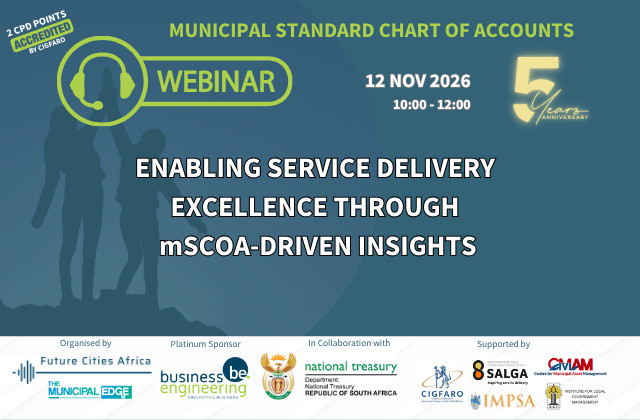
Upcoming Webinars

Recommended Podcasts

